

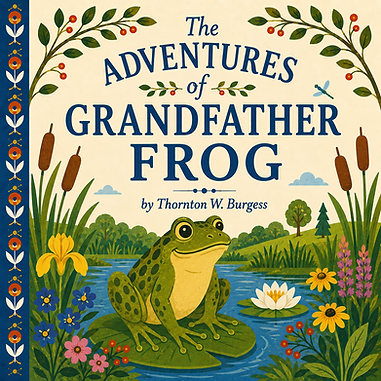
The Adventures of Grandfather Frog
By Thornton W. Burgess
Published 1915
Grandfather Frog is one of the oldest residents of the Smiling Pool. He is famous for his deep voice, his big green lily pad, and his love of catching foolish green flies. Grandfather Frog has been around for a long time and thinks he knows quite a bit about the world, even though he rarely ventures far from his comfortable home.
One day, Grandfather Frog decides it is finally time to see the Great World for himself. He leaves the safety of the Smiling Pool and soon discovers that traveling isn't quite as easy as he expected. His journey brings surprises, close calls, unexpected help, and plenty of reasons to wish for his familiar lily pad again.
The Adventures of Grandfather Frog is a humorous story about stepping outside your comfort zone and discovering that there is always something new to learn. Grandfather Frog's adventures remind readers that wisdom doesn't mean knowing everything and that sometimes experience is the very best teacher.
Main Themes: Wisdom, Humility, and Learning from Experience

Nature & Character Connection
The Bullfrog: A Master of Patience
Grandfather Frog is a large American Bullfrog. In nature, bullfrogs are known for sitting very still for a long time. They do this so they can surprise their food and stay hidden from hungry birds. Burgess shows us how Grandfather Frog is a master of patience. This reflects real life because bullfrogs use their big eyes to watch for movement while keeping their bodies perfectly still. This teaches students that being quiet and patient is a very important skill for survival.
The Sticky Tongue: A Quick Tool
In the story, Grandfather Frog is excellent at catching flies. In the real world, a frog has a very long and sticky tongue that is attached to the front of its mouth. It can flip its tongue out and back in faster than you can blink! This is how a frog eats without having to chase its food. Burgess uses this to show that every animal has a "special gift" that helps them live. For Grandfather Frog, his gift is his quick tongue and his great aim.
Amphibian Life: Two Worlds in One
Grandfather Frog is an amphibian. This means he can live in the water and on the land. In the book, he spends a lot of time on his lily pad but can dive deep into the Smiling Pool to hide. Real frogs have skin that needs to stay wet to help them breathe. When Grandfather Frog goes on his trip away from the water, he starts to feel very uncomfortable. This teaches children that every animal has a specific habitat where they belong and feel their best.

Simple Activity Ideas
The Lily Pad Leap: Place green paper "lily pads" on the floor in a path. Have students jump from one to the next like Grandfather Frog. Discuss how his strong back legs help him move so far in one leap.
Tongue Flip Game: Give students a party blower or a piece of sticky tape on a straw. See if they can "catch" a paper fly from across a desk. This shows how fast a frog must be to get its dinner.
The Life Cycle Wheel: Draw a circle and divide it into sections. Have students draw an egg, a tadpole, and a frog to show how Grandfather Frog grew up.
Discussion Prompts
On Wishing: Why did Grandfather Frog want to leave the Smiling Pool? Have you ever wanted to go somewhere new and then missed your home?
On Boasting: Grandfather Frog sometimes likes to talk about how smart he is. What happens when he stops being humble and starts to brag?
On Safety: Why is the Smiling Pool the safest place for a frog? What things make your home a safe place for you?
Morals & Values Learned
There is No Place Like Home: We learn to appreciate the safety and comfort of our own surroundings.
The Danger of Pride: Grandfather Frog shows us that thinking you know everything can lead to big mistakes.
Respect for Elders: The other animals look up to Grandfather Frog for his stories and his age. This teaches us to value the wisdom of those who are older than us.
Patience: We see that being calm and waiting for the right moment is often the best way to succeed.
Public Domain Notice: The original text of this book is in the public domain. Site layout, study guides, and supplemental materials are © burgess-books.com.
