The Striped Skunk
The Forest's Quiet Searcher
The Striped Skunk is a house-cat-sized mammal found all across North America, known in the Thornton Burgess stories as Jimmy Skunk. They are famous for their bold black-and-white stripes, bushy tails, and their powerful scent spray defense system. They are quiet, gentle-natured insect hunters who spend their nights shuffling through fields and yards in search of snacks.

RANGE
Striped skunks are native to North America. They live throughout most of the United States, southern Canada, and northern Mexico, adapting easily to wild forests, open farmlands, and suburban neighborhood yards.

HABITAT
These nocturnal creatures prefer open woodlands, grassy fields, brushy pastures, and suburban areas. They make their homes in underground dens, hollow logs, rock piles, or abandoned burrows dug by other animals like woodchucks.

DIET
Insect Munchers: Skunks are omnivores, but their absolute favorite foods are insects like grubs, beetles, grasshoppers, and crickets.
Egg Hunters: They use their keen sense of smell to dig up ground-nesting bird eggs, turtle eggs, and bumblebee nests.
Small Prey: They also enjoy eating mice, frogs, crayfish, berries, fallen fruit, and wild mushrooms.
Yard Foragers: In neighborhoods, they often dig small, shallow holes in lawns to snip out plant-damaging grubs.

SIZE & WEIGHT
An adult striped skunk is about the size of a house cat, measuring 20 to 30 inches long including its fluffy tail. They usually weigh between 4 and 10 pounds, gaining extra weight in the fall to prepare for cold winter naps.

LIFE CYCLE
Spring Kits: Females give birth to a litter of four to seven tiny babies, called kits, in May or June.
Born Blind: Kits are born blind and helpless, but they already have their distinct black-and-white stripe pattern showing on their skin.
Parade Following: When the kits are about seven weeks old, they leave the den to follow their mother in a single-file line to learn how to hunt for bugs.
Winter Naps: Skunks do not fully hibernate, but they sleep deeply in their cozy dens for weeks at a time during freezing winter weather.

PREDATORS
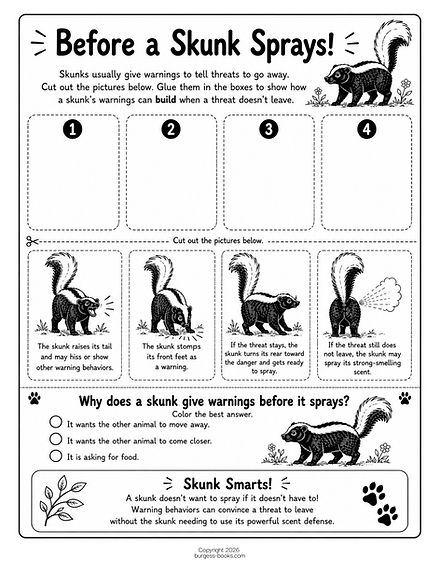
Because of their famous protective spray, most land predators like coyotes, foxes, bobcats, and domestic dogs quickly learn to leave skunks alone. However, their main natural threat comes from the sky! The Great Horned Owl has almost no sense of smell, making it the top predator of the striped skunk. If a land predator approaches, a skunk tries hard to avoid spraying because it takes days to make new musk. Instead, it gives clear warnings first: it arches its back, lifts its bushy tail high, stamps its front feet hard against the ground, and huffs. If the intruder ignores these warnings, the skunk twists into a U-shape and delivers its foul-smelling spray right toward the predator's face.

Amazing Adaptations
Digging Claws: Skunks have long, curved front claws perfect for ripping open rotten logs and scooping grubs out of the soil.
Built-in Defense: They carry a specialized musk spray that can reach targets up to ten feet away with incredible accuracy.
Night Vision & Smell: Because their eyesight is somewhat weak, they rely on a powerful sense of smell and sharp hearing to navigate in the dark.
Immunity to Stings: Their thick fur and natural toughness allow them to dig up stinging yellowjacket and bumblebee nests without getting hurt.

Animal Talk

How Do Striped Skunks Communicate?
Striped skunks would rather warn a predator than spray it! They use foot stomps, body movements, sounds, and their bold black-and-white coloring to tell other animals to keep their distance.
Stomp! Stomp!: When a striped skunk feels threatened, it may stamp its front feet, raise its tail, and face the danger. These warning signals give the other animal a chance to back away before the skunk sprays.
Hisses & Other Sounds: Skunks can make a variety of sounds, including hisses, squeals, grunts, and soft chattering noises. Mothers and kits also use vocalizations to communicate with one another.
Warning Colors: A skunk's bold black-and-white pattern acts as a visual warning to predators. Scientists call this kind of warning coloration aposematism—bright or noticeable markings that advertise an animal's defenses.
Fun Animal Talk Fact: A skunk usually gives several warnings before spraying. It may stomp its feet, raise its tail, hiss, or change its body position. Spraying is an important defense, so a skunk doesn't want to waste it when a warning will do!
Respecting Wildlife
Natural Pest Control: Welcome skunks as helpful nighttime yard cleaners who naturally rid your garden of grubs, mice, and yellowjackets.
Block Den Access: Secure crawlspaces, porch undersides, and shed foundations with wire mesh before spring so skunks do not build dens under your house.
Secure Trash & Food: Keep outdoor trash can lids tightly sealed and pick up leftover pet food so skunks stay focused on their natural diet.
Leash Nighttime Pets: Before letting dogs out in the yard at night, turn on a porch light or make some noise so any foraging skunk has time to amble away safely.
Striped Skunk Photos