

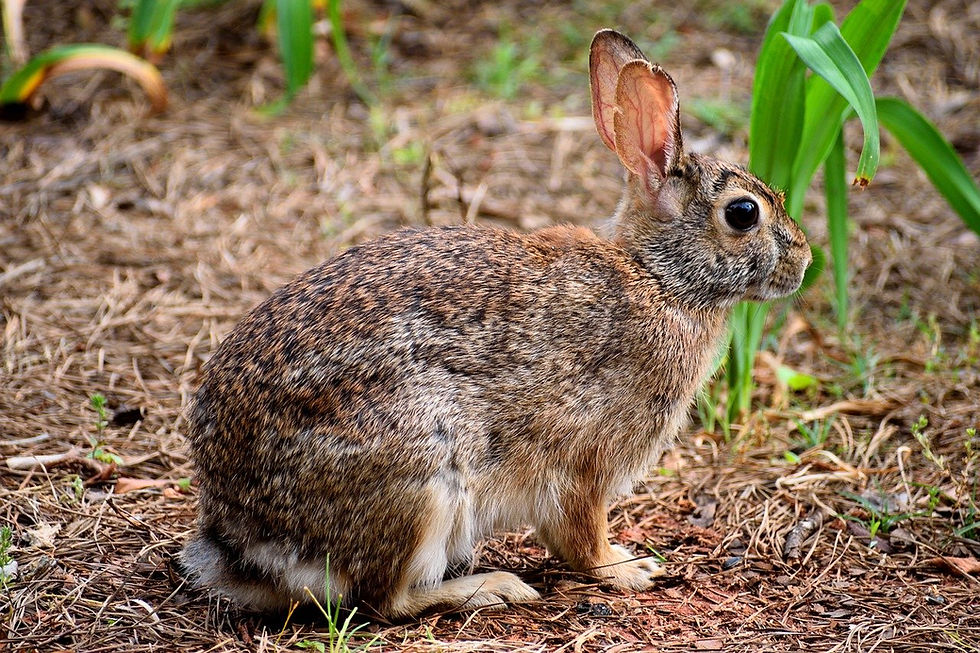
The Eastern Cottontail Rabbit
The Quick-Footed Neighbor
The Eastern Cottontail is the most common rabbit in North America. They are famous for their brown, speckled fur and their fluffy white tails that look like a ball of cotton. These rabbits are very fast and spend most of their time in meadows and gardens.

RANGE
Eastern Cottontails are found across the eastern and central United States. You can find them as far north as southern Canada and as far south as Central America. They are very successful animals and can live in many different climates.

HABITAT
These rabbits love open areas with plenty of places to hide. You can find them in meadows, orchards, and even your own backyard! Instead of digging deep tunnels like some other rabbits, the cottontail makes a "form." This is a shallow nest in the grass or under a prickly bush where they can sit and stay hidden.

DIET
Cottontails are herbivores and eat a wide variety of plants.
Green Snacks: In the spring and summer, they love to eat clover, grass, and dandelions.
Garden Guests: They often visit gardens to munch on lettuce, peas, and carrots.
Winter Food: When the grass is covered in snow, they eat the bark and twigs of woody plants to stay full.

SIZE & WEIGHT
A cottontail is a medium-sized rabbit. They are usually between 13 and 19 inches long. They are very light and built for speed, usually weighing between 2 and 4 pounds. That is about the same as a small toaster or two loaves of bread!

LIFE CYCLE
Mother rabbits, called does, are famous for having many babies to keep their family strong.
A mother can have 3 or 4 litters of babies every single year!
Baby rabbits are called kits or kittens.
The mother hides the kits in a nest lined with her own soft fur and grass.
Kits grow very fast and are ready to leave the nest and eat clover when they are only three weeks old.

PREDATORS
The Eastern Cottontail Rabbit is a very important food source for many different animals, so it must stay alert at all times to survive. From the sky, hawks and owls are constantly watching for any movement in the grass, while on the ground, foxes, coyotes, and even neighborhood cats are always on the hunt. To stay safe, the rabbit uses its incredible hearing to listen for the tiniest rustle and its large eyes to see in almost every direction at once. If a predator gets too close, the rabbit will either "freeze" to blend in with the brown leaves or use its powerful back legs to zig-zag away at high speeds toward the safety of a thick briar patch or a brush pile.

Amazing Adaptations
The cottontail has several tools to help it survive in a world full of predators.
Springy Legs: Their powerful back legs allow them to leap up to 15 feet in a single jump!
Big Ears: Their long ears can move in different directions to listen for the smallest sound of a predator sneaking up.
Wide Vision: Their eyes are on the sides of their head, which lets them see almost all the way around their body without moving.

Animal Talk

How Do Eastern Cottontails Communicate?
Eastern cottontails are usually very quiet, but that doesn't mean they have nothing to say! They communicate using foot thumps, body movements, scents, and a few vocal sounds.
Thump! Thump!: When a cottontail senses danger, it may stamp or thump its powerful hind feet against the ground. The sound and vibrations can warn other rabbits nearby that something isn't right.
Body Talk: Cottontails use their ears, posture, and movements to show how alert or relaxed they are. A rabbit that suddenly freezes with its ears raised is listening carefully and watching for danger.
The Distress Scream: Cottontails are generally quiet, but a rabbit that is caught or in extreme distress may let out a sudden, high-pitched scream. It's a sound they normally make only in serious danger.
Fun Animal Talk Fact: That famous white tail can act as a visual signal. When a cottontail bounds away, its bright white tail flashes against the surroundings, where other rabbits may notice the movement and become alert.
Respecting Wildlife
Cottontails are one of the animals we see most often in our neighborhoods, and it is easy to be a good friend to them.
Safe Gardening: If you want to keep rabbits out of your vegetable garden, a short fence made of chicken wire is the best way. This keeps your veggies safe without hurting the rabbits.
Mowing Safety: Before mowing the lawn in the spring, it is a great idea to check for "forms" or small patches of dead grass. There might be a nest of baby rabbits hiding inside!
Natural Snacks: Planting native grasses and clover in a corner of your yard provides a perfect, safe snack for your rabbit neighbors.
Cottontail Rabbit Photos


